By Nikos Vatopoulos
New and older works come together in Nikos Moschos’s exhibition “Marginally Human” at the Basilica of Saint Mark in Heraklion.
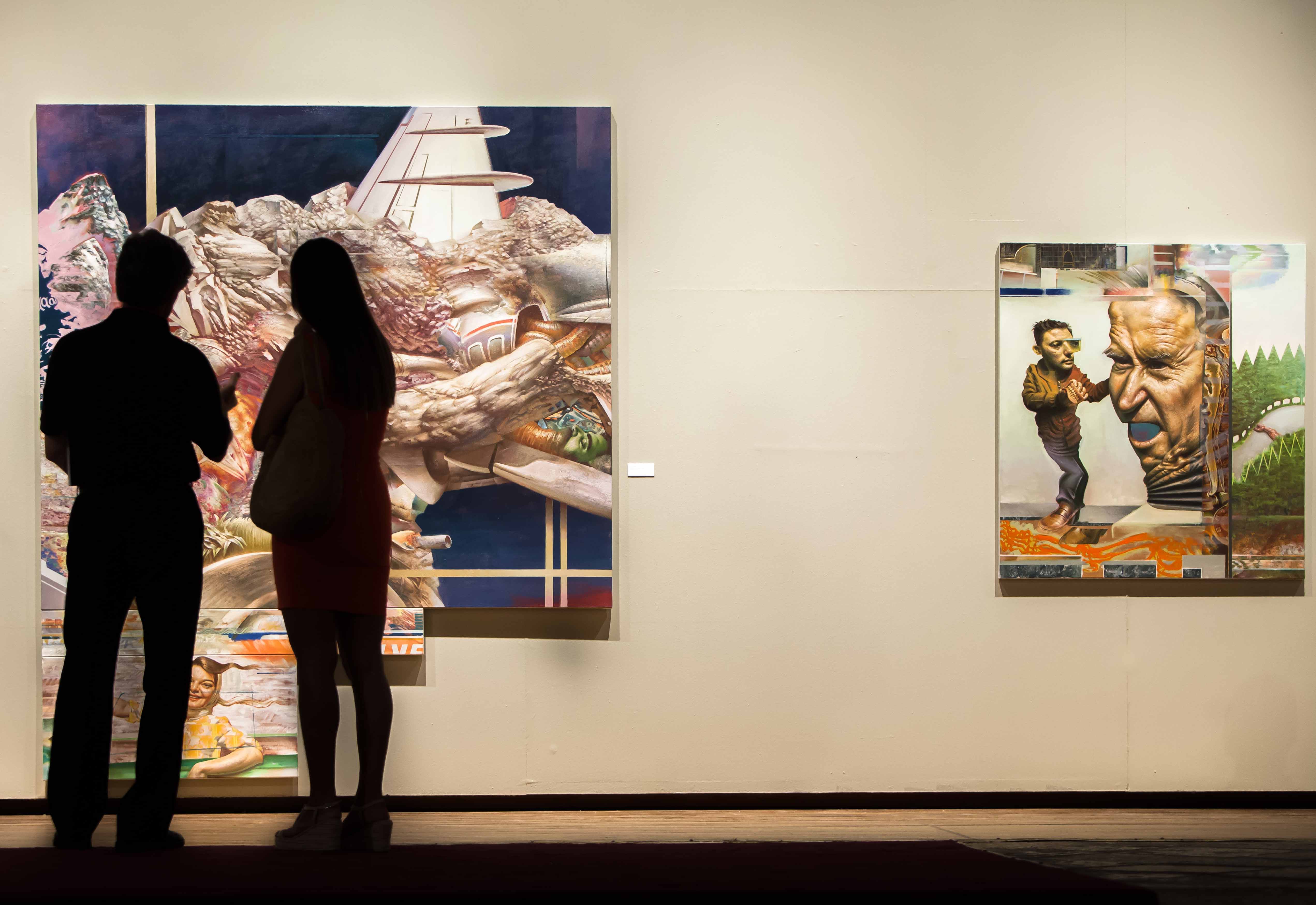
Inside the Basilica of Saint Mark, Moschos’s works create a visual universe of intense inner dynamism. His painting carries tensions, spasms, and reversals within an unpredictable and fluid world — in a way, one might say, foundational to its own genesis. In this evocative environment, which alludes to the Venetian past of the artist’s birthplace, visitors have the opportunity to witness the evolutionary stages of Moschos’s visual language, from 2012 to the present — a journey of continuous exploration within a distinct and recognizable style. A style that Moschos defined early on and has since cultivated while evolving.
The opening of “Marginally Human” was a cultural event organized and supported by the Region of Crete, with the exhibition running until the end of August. The Basilica of Saint Mark, now equipped with modern infrastructure for major and significant events, is becoming more actively integrated into the cultural life of Heraklion.
Nikos Moschos is, in a sense, making a return to his hometown, where his artistic roots lie (his father is the notable artist and iconographer Takis Moschos). This return — armed with an achieved maturity and a growing boldness — is framed and defined by the conditions of a new starting point.
The new works presented alongside earlier ones (dating back to his solo exhibition at Xippas Gallery and beyond) retain all the familiar expressionistic elements: the absence of empty space, the large forms, the narrative quality, the fragmentation, and the coexistence of overlapping stories. Yet now, all of these appear more mature, with their genetic material absorbed into a kind of cellular memory.
There is no doubt that Nikos Moschos is a master craftsman, with exceptional drawing skills of the highest caliber. He could have been a very commercially successful figurative painter, but from an early age — whether through ambition or temperament — he chose a difficult path of personal differentiation.
His painting carries as a constant refrain a philosophical undercurrent of futility and sarcasm, combined with a Dionysian spirit — more as Kubrick might have understood it, rather than Fellini. Moschos’s visual idiom relinquishes any overt national or local identity in favor of an international a-topia, yet in a way that remains cohesive and personal. Within his work (which can readily speak to an international audience) lie the seeds of his formative influences: likely the iconographic tradition inherited from his father, as well as his exposure to the Great Masters of the Renaissance and Baroque. All these influences, Moschos metabolizes into a chromatic and stylistic language now in full bloom in Heraklion.
An excellently printed catalogue, published by Macart – M. Varouxis and designed by Michalis Moschos, accompanies the exhibition. The text by Christoforos Marinos is of particularly high quality.